Customer feedback themes
Turn scattered feedback into a clear, calm dashboard of ranked themes and supporting evidence.
Read this prompt as Markdown or plain text
When to use it
The prompt starts from the decision the dashboard supports, then constrains hierarchy, density, semantics, and responsive behavior.
Prompt
Design and implement a customer-feedback themes dashboard for [PRODUCT OR TEAM]. Inspect the current app conventions before editing.

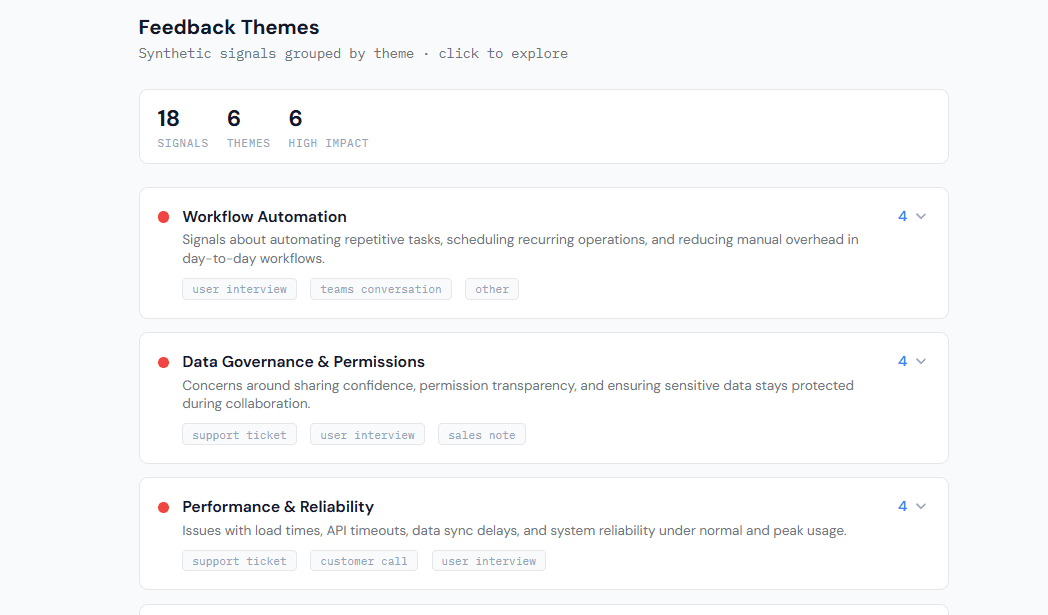
The page should help someone answer: what matters most, why, and what should we inspect next? Include a compact summary, ranked theme rows or cards, impact and trend signals, source counts, and a detail view with representative feedback. Use realistic, concise seed data.

Favor an analytical editorial style: high information density without clutter, neutral surfaces, one semantic accent, aligned numbers, readable labels, and subtle separators. Do not rely on color alone. Make the highest-impact theme visually obvious while preserving scanability.

Implement search, impact sorting, a time-range filter, theme selection, and empty/loading/error states. On narrow screens, preserve the ranking and core evidence instead of squeezing desktop columns. Use semantic tables or lists where appropriate, accessible controls, visible focus, and reduced-motion-friendly transitions.

Do not copy source branding or text. Use the source output only as a quality and hierarchy reference.

Test the interactions and render at [DESKTOP WIDTH] and [MOBILE WIDTH]. Report changed files, validation commands, and screenshots of the overview plus one selected theme.
Adapt it to your task
Adapted from Feedback Themes' grouped customer-signal interface and committed preview.
Third-party prompt. Source review does not establish benchmark performance or guarantee an outcome.
Reviewed source output
Source and license
Contributor: @jamesmontemagno. Repository: github/awesome-copilot.
License: MIT. Pinned commit: b95e24caae4f25c5985f8527fd092ccfed039c36.

Review: output-reviewed, . Reviewed the commit-pinned implementation and its committed preview image. The preview is representative source output, not a claim that this adapted prompt reproduces it pixel-for-pixel.